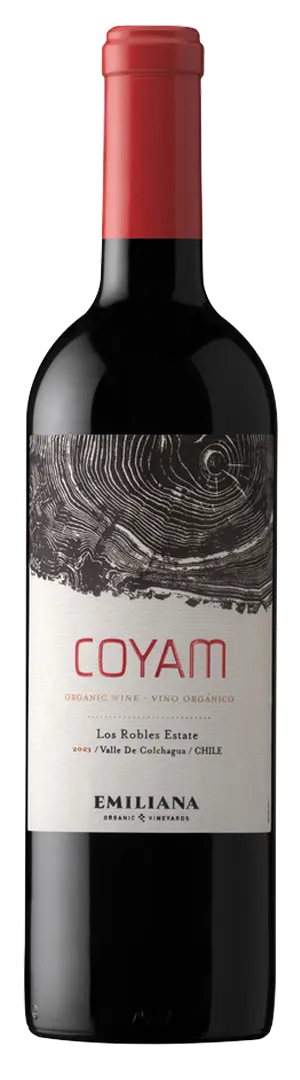
Owners: Viñedos Emiliana S.A.
Head Winemaker: Noelia Orts, Head Winemaker of Premium Wines
Website: www.emiliana.bio
Commercial Contact: dbaeza@emiliana.cl
 History
In the late 1990s, Rafael and José Guilisasti showed remarkable foresight in recognising that consumers were becoming increasingly conscious of the products they chose, considering not only their health benefits but also their environmental and social impact. Driven by this vision, they began transforming a traditional Chilean winery, moving towards 100% organic practices with the aim of producing high-quality wines in harmony with nature and people.
More than two decades later, Emiliana has nearly 1,000 hectares of organically farmed vineyards across seven sites throughout Chile. A pioneer in this field, it was the first Chilean winery to produce a certified organic wine, Coyam. Its commitment to sustainability is supported by international certifications including Organic, The Vegan Society's Vegan certification, Regenerative Organic Certified (ROC) and B Corp.
Its philosophy views the vineyard as a living ecosystem and seeks to reconnect people with nature through organic and regenerative farming, respecting natural cycles and eliminating the use of chemicals and pesticides. This commitment extends beyond the vineyard through initiatives aimed at reducing its carbon footprint, promoting a circular and community-based economy through vermicomposting projects and the production of its own compost, and protecting biodiversity. Emiliana currently dedicates 836 hectares exclusively to the conservation of native flora and fauna, helping to build healthier, more resilient ecosystems.
Vineyards
La Vinilla – Casablanca Valley
Located at Fundo Cordillera, at 300 metres above sea level, La Vinilla is trained on a trellis system, with an east–west orientation and drip irrigation. The climate is cool and strongly influenced by the Pacific Ocean and the Humboldt Current, which bring persistent humidity and average temperatures of 25 °C in summer and 14 °C in winter. These conditions provide an ideal environment for slow, even ripening, allowing the grapes to develop and express themselves fully.
The soils are deep and granitic in origin, derived from the Coastal Range, with a good balance of clay, silt and sand. They range from evolved clays to yellow decomposed granite, contributing different characteristics to the vineyard's expression. The absence of a water table also allows for more precise management of the water available to the vines.
Fundo Los Robles – Colchagua Valley
Located in Lo Moscoso, in the foothills of a mountain range and 800 metres from the Tinguiririca River, Fundo Los Robles lies at 260 metres above sea level and is surrounded by sclerophyll forest. The vineyards are trained using vertical shoot positioning and have a southerly aspect, resulting in fewer hours of sunlight. The vines were planted in 1992, 1995, 1998 and 2000, and the principal varieties are Carménère, Cabernet Sauvignon and Syrah. Most are own-rooted massal selections, while the Syrah is also own-rooted but comes from clonal material.
The soils lie on a ridge running across the Coastal Range and are predominantly volcanic in origin, with red granite, andesite, basalt and rhyolite. They are mainly colluvial, with abundant stones both on the surface and at depth. The proximity of the Tinguiririca River also gives rise to areas with fluvial deposits of sand and silt. Textures range from clay loam to sandy loam, with low to moderate levels of organic matter.
Campo Lindo – Limarí Valley
Located in Ovalle, 34 kilometres from the coast and alongside a ravine that meets the Limarí River from the south, Campo Lindo is planted with Pinot Noir and Chardonnay. The vineyards were established in 2011 and are trained using vertical shoot positioning with double Guyot pruning, a north-east–south-west orientation and drip irrigation.
The soils are deep and alluvial in origin, with well-defined horizons. The upper 30 centimetres consist of a layer of clay, followed by layers of rounded stones containing carbonates and sandy-loam strata. At greater depth, the roots penetrate a horizon of dark clay. The soils have low levels of organic matter and low salinity.